
Why Uji Matcha Is Different: Japan's Most Celebrated Tea Region
Uji has produced Japan's finest matcha for over 800 years. Here is what makes its geography, farming methods, and cultivation practices consistently produce better matcha than anywhere else.
Short answer: Uji, a small city south of Kyoto, has produced Japan's finest matcha continuously since the 13th century. Its river valley geography, accumulated farming expertise, and precisely timed shading practices produce higher L-theanine content, more vivid colour, and greater flavour complexity than any other Japanese region.
Most matcha is labeled "from Japan." That label says almost nothing about quality. Where in Japan matters, and for matcha, Uji is the benchmark.
Why Has Uji Been Dominant for 800 Years?
Uji, a small city south of Kyoto, has been growing tea continuously since the 13th century. The cultivation methods, shading techniques, and stone-milling practices have been refined across generations, not developed by a single company or set by an industry standard.
The historical starting point is well documented. In the early 13th century, the Buddhist monk Myoe Shonin brought tea seeds from China to Japan, planting them first in Toganoo and then in Uji. The region south of Kyoto proved quickly superior, and proximity to the imperial capital Kyoto gave Uji farmers direct access to the highest-paying buyers of the era: the aristocracy, Buddhist monasteries, and samurai leadership.
Over centuries, Uji tea was used by shoguns, including Tokugawa Ieyasu, as a diplomatic gift and marker of status. That political and cultural significance maintained pressure to produce at the highest level. Quality was, and still is, existential rather than optional.
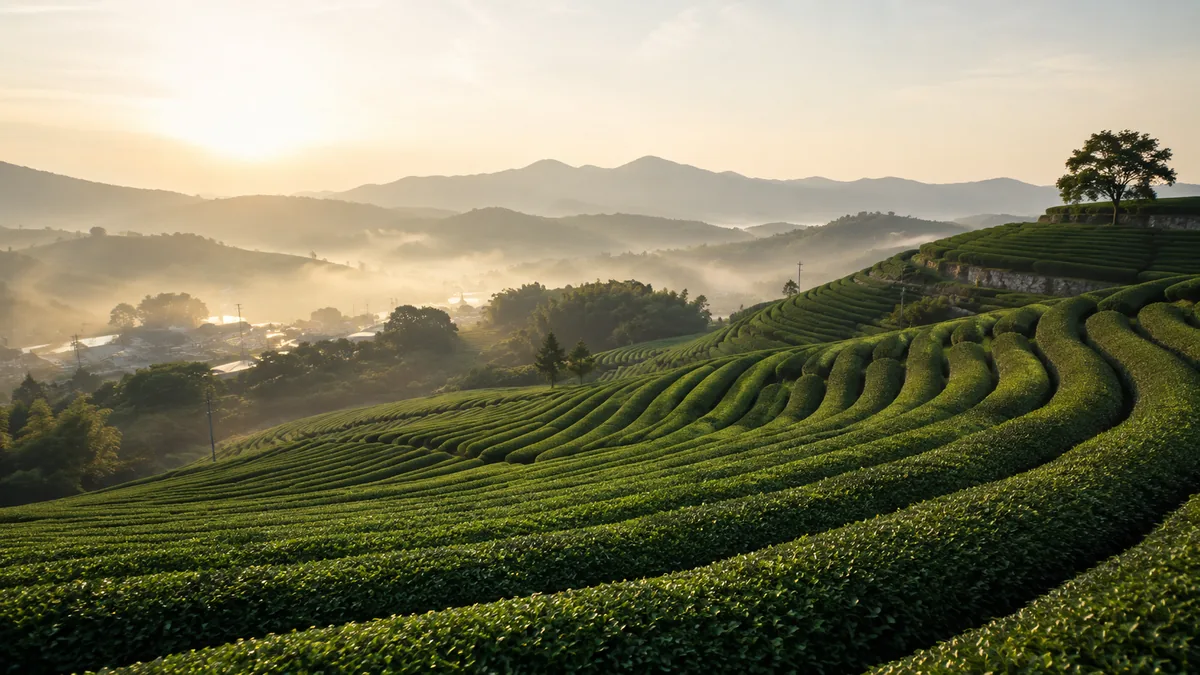
Within the Uji region, two areas stand out for the most concentrated production of premium quality: Wazuka and Uji-Tawara. Wazuka is a narrow mountain valley with steeply terraced tea gardens and is one of the most photographed tea-growing landscapes in Japan. Uji-Tawara sits further into the hills and is known for producing some of the most prized tencha used in ceremonial matcha.
That accumulated knowledge shows up in the cup.
How Does Uji's Geography Produce Better Matcha?
Uji sits in a river valley between the Uji and Kizu rivers. The geography creates specific growing conditions that cannot simply be replicated elsewhere by applying the same farming methods:
- Morning mist from the rivers: natural humidity that softens light intensity during critical growth phases
- Temperature differential: warm days and cool nights slow plant growth and concentrate flavor compounds
- Mineral-rich alluvial soil: built from centuries of river sediment, providing a unique nutrient composition
- Natural slope: the hillside gardens surrounding the valley ensure good water drainage and prevent waterlogging
These conditions are specific to the place. Other Japanese growing regions, such as Kagoshima in the south or Nishio in Aichi Prefecture, have their own qualities, but the climate and the tradition of manual craft differ substantially.
Uji vs. Nishio vs. Kagoshima
| Region | Strengths | Notes |
|---|---|---|
| Uji (Kyoto) | Flavor complexity, tradition, L-theanine content | First choice for drinking-quality matcha |
| Nishio (Aichi) | High volume, consistent ceremonial-grade quality | Strong for everyday ceremonial and culinary |
| Kagoshima | Affordable, large quantities | Mild climate, but less depth |
Nishio is Japan's second-largest matcha-producing region and delivers reliable ceremonial-grade quality. Kagoshima produces in large volumes, primarily for industrial and culinary applications. Uji leads when flavor complexity, umami depth, and natural sweetness are the primary criteria.
How Is Matcha Shade-Grown in Uji?
The defining practice of premium matcha production is shading: covering tea plants with cloth or reed screens for 20–30 days before harvest. This has measurable biochemical consequences:
- Blocks direct sunlight, causing the plant to produce more chlorophyll (the vivid green color) and L-theanine (the amino acid responsible for sweetness and calm alertness)
- Reduces catechins, the compounds that cause bitterness in unshaded green tea
The biochemical mechanism is well understood. Without direct sunlight, the plant cannot convert L-theanine into catechins at the normal rate. L-theanine therefore accumulates in the leaves. Shaded matcha contains measurably more L-theanine than unshaded green tea, which directly produces a milder, sweeter flavor profile. Research on L-theanine and its physiological effects has been published on PubMed.
Uji farmers have refined the timing and method of shading over centuries. The difference between 20 days and 30 days of shading is measurable in both chemistry and flavor. Traditional growers in Wazuka and Uji-Tawara still use the older method of reed screens (tana), which diffuses light more gently than synthetic coverings and provides additional humidity regulation around the plant.
What Is a First-Flush Harvest and Why Does It Matter?
Only the youngest leaves, picked once in spring before the summer heat arrives, produce drinking-quality matcha. In Uji, this is typically late April to early May.
The window for the first flush is narrow: often only ten to fourteen days. During this period, the leaves are most tender, contain the highest concentration of L-theanine and chlorophyll, and have the lowest catechin content. Weather is a determining factor. A late frost or premature heat at the wrong moment can reduce the quality of an entire vintage.
Second and third harvests use more mature leaves with more developed bitterness. They produce culinary-grade matcha, suitable for cooking but not for drinking straight.
The Key Cultivars Grown in Uji
Quality depends not only on location and harvest timing but also on cultivar. Uji grows several varieties that differ in flavor profile and L-theanine content:
- Okumidori: one of the most widely grown cultivars in Uji, deep green color, balanced umami, strong tolerance for shading
- Samidori: milder and sweeter in profile, frequently used for top-grade ceremonial matcha
- Uji Hikari: a traditional variety known for particularly vivid green color and intense aroma
Serious producers name not just the region but the cultivar. This allows buyers to compare vintages and develop preferences over time.
How Is Uji Matcha Processed?
After harvest, Uji leaves are steamed immediately to stop oxidation. This steaming step is what fundamentally distinguishes Japanese green tea from Chinese green tea, which is pan-fired instead. Steaming preserves chlorophyll and L-theanine completely, maintaining both the vivid color and the sweet flavor compounds.
The steamed leaves are then dried and stripped of stems and leaf veins. What remains is called tencha, the raw material for matcha.
Tencha vs. Gyokuro: Gyokuro is also shade-grown and steamed, but the leaves are rolled into long needles and then used as a whole-leaf infusion. Tencha remains flat and is milled into powder. Both share similar growing conditions, but the processing paths diverge. The key distinction for matcha buyers is that tencha is milled, not steeped. Its flavor profile was designed for suspension in water rather than for infusion.
How Stone Mills Work
Tencha is milled using granite millstones rotating at low speed. The typical rotation rate is 30–40 revolutions per minute, far slower than what mechanical mills could achieve. The slowness is the point.
High-speed milling generates heat through friction. Temperatures above 40°C begin to oxidize chlorophyll and degrade amino acids. Stone-milling at low RPM keeps the temperature of the ground powder low and preserves both. One 30g tin of matcha requires over an hour to mill using traditional stone grinding.
The millstone itself plays a role. Granite from specific quarries has a pore structure that regulates particle size during milling. Matcha particles should be below 10 micrometers, finer than wheat flour and finer than most other ground substances used in cooking. This fineness enables full suspension in water rather than settling out quickly.
Why Does Direct Import Matter for Freshness?
Matcha oxidizes quickly after milling. Light, oxygen, and heat all attack chlorophyll and amino acids. Every additional distributor in the supply chain means more storage time and more exposure to temperature fluctuations.
Direct import, with no distributor between the farm and the final packaging, minimizes this time. Fresh matcha has deeper green color, a more pronounced aroma, and more perceptible natural sweetness than matcha that has spent months in warehouses, even if both originated from the same harvest.
How to Verify Origin Claims
Generic labels like "Japan Matcha" or "Premium Green Tea Powder" say nothing about actual provenance. Reliable origin labeling includes:
- Region: "Uji, Kyoto" rather than just "Kyoto" or "Japan"
- Ideally the specific locality: Wazuka, Uji-Tawara, or similarly specific
- Harvest timing or vintage year
- Cultivar name when available
The Japan Tea Central (Nihoncha Instructor Association) maintains official educational and certification standards for tea knowledge in Japan and is a reliable reference for understanding Japanese tea classifications and authenticity indicators.
Why Does Origin Matter When Buying Matcha?
When you buy matcha labeled "single-origin Uji," you are buying a product where every stage, from climate and soil to shading practice, harvest timing, cultivar selection, and milling method, is traceable to a specific place and a specific set of decisions.
This traceability is practical, not just philosophical. It means that when a batch is exceptionally good or noticeably different from the previous one, the reason can be identified and understood. It also means the producer has accountability that blended or generic Japanese matcha does not carry.
Satsuki sources exclusively from Uji, Kyoto and imports directly, with no distributor between the farm and your tin. The full range is available in the shop. For wholesale or larger orders, the wholesale page has the relevant information.
For ongoing coverage of matcha sourcing, production trends, and quality indicators in the Japanese tea market, World Tea News publishes reliable industry reporting and is worth following if you want to track how Uji's position evolves in the global tea trade.