
Ceremonial vs Culinary Matcha: The Complete Guide
Understand the real differences between ceremonial and culinary matcha grades: shading time, processing, flavor profile, and when to use each.
Short answer: Ceremonial matcha is made from the youngest leaves after 20–30 days of shading, and is designed to be drunk straight. Culinary matcha comes from later harvests with less shading, and is suited for baking and strongly flavored drinks. If you are drinking it, always buy ceremonial grade.
Ceremonial matcha is for drinking straight; culinary matcha is for cooking and flavored drinks. The difference comes down to shading duration, harvest timing, and stone-milling precision.
What Is the Real Difference Between Ceremonial and Culinary Grade?
Matcha grade is not an official certification; it reflects a combination of production choices that determine flavor, texture, and color.
The two most important factors are shading duration (which controls amino acid and chlorophyll content) and which part of the leaf is used (younger leaves produce lower bitterness).
Before shading begins, the tea plant produces L-theanine primarily in its roots and transports it to the leaves. Under sunlight, the plant converts that L-theanine into catechins, the bitter polyphenols that act as UV protection. Shading interrupts this process: the plant accumulates L-theanine in the leaves without breaking it down. That biochemical mechanism is the foundation of every quality difference between grades.
Tencha is the intermediate stage between raw leaf and finished matcha. It refers to the shaded, steamed, and dried leaves before they are milled. The quality of the tencha determines the quality of the matcha. High-quality tencha leaves are thin, evenly shaded, and fully de-stemmed; lower-quality tencha contains thicker leaf segments with lower amino acid density. The Japan Tea Instructors Association classifies tencha into several internal grades, but these are not publicly standardized. The terms "ceremonial" and "culinary" are trade designations, not official certifications.
Ceremonial vs Culinary: The Numbers
| Factor | Ceremonial Grade | Culinary Grade |
|---|---|---|
| Shading before harvest | 20–30 days | 10–15 days |
| Harvest flush | First (spring) | Second or third |
| Leaf selection | Top two leaves only | More mature leaves |
| Stone-milling speed | Slow (slow = cool) | Faster |
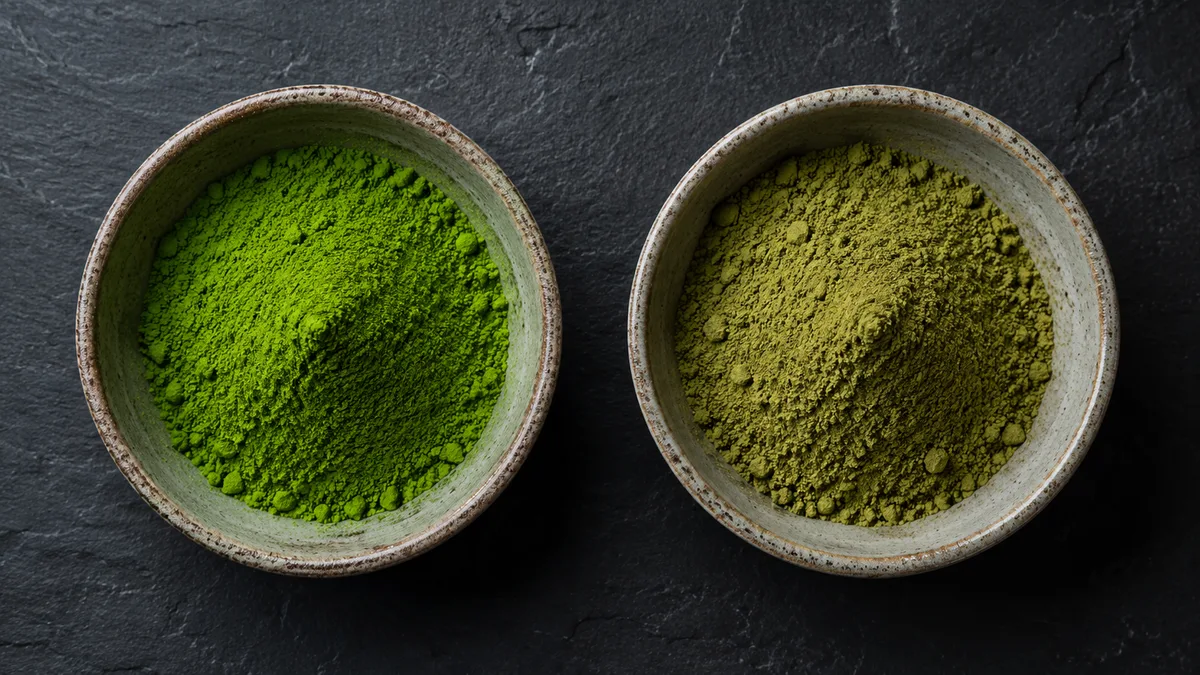
| Color | Vivid emerald green | Olive to yellow-green |
| Flavor | Sweet, umami, smooth | Bitter, grassy, bold |
| Caffeine (per 2g) | ~68 mg | ~68–80 mg |
| L-theanine (per 2g) | ~25–30 mg | ~15–20 mg |
| Typical price (30g) | €25–45 | €10–20 |
How Does Shading Duration Affect Flavor?
Tea plants shaded before harvest produce more L-theanine (an amino acid that creates sweetness and calm alertness) and chlorophyll (the source of the vivid green color). Unshaded plants convert L-theanine into catechins, the bitter compounds.
The numbers make the effect concrete: after 10 days of shading, the leaf contains roughly 15 mg L-theanine per gram of dry weight. After 20 days that rises to 20–25 mg; after 25–30 days it reaches 28–35 mg. Simultaneously, total catechin content drops from a typical 12–15% in unshaded tea to 6–9% in heavily shaded ceremonial-grade matcha. The flavor impact is direct: less astringency, more vegetal sweetness, longer umami finish.
Uji farmers determine the optimal shading window through a combination of experience, weather data, and leaf color observation. Shading too early can suppress the sugar buildup in leaves; shading too late misses the optimal L-theanine accumulation window. Established tea gardens in Uji have refined these timings over generations, which is a primary reason Uji matcha consistently outperforms other origins. More on Japanese tea production culture is documented by Japan Tea Central.
30 days of shading produces noticeably sweeter, more complex matcha than 10 days. This is why ceremonial-grade matcha from Uji, the region with the most refined shading practices, consistently outperforms bulk-imported alternatives.
What Is the "Premium Culinary" Myth?
Some brands sell "premium culinary" matcha at prices close to ceremonial grade. This is mostly marketing language without a meaningful production difference.
The only substantive distinction is first-flush ceremonial (first harvest, 20+ days shading, youngest leaves) versus everything else. "Premium culinary" typically describes matcha from the second harvest with 15–18 days of shading, which is better than standard culinary but weaker than genuine ceremonial. If a matcha is too bitter to drink straight, it is not ceremonial grade, regardless of the packaging.
The price-to-quality relationship follows a clear curve: under €10 per 30g is typically second- or third-harvest commodity material, often with undisclosed origin. €15–25 is standard culinary-grade territory from Nishio or other production regions. From €25–30 upward begins genuine ceremonial grade. Prices above €40 for small quantities usually reflect rare cultivars or hand-sorted first pickings. Prices significantly above €60 per 30g without transparent origin disclosure deserve skepticism.
How Do I Identify High-Quality Matcha by Looking at It?
High-quality matcha has a distinct visual and olfactory profile. These three quick tests are reliable:
Color check: Good ceremonial matcha is vivid, cool emerald green. Olive-green, yellow-green, or brownish tones indicate either oxidative degradation (old matcha), heat damage during milling, or inferior raw material. The green color comes from chlorophyll a, which degrades to pheophytin under heat or oxygen exposure, turning olive-colored in the process.
Smell test: Good matcha smells fresh, vegetal, and slightly sweet; experienced drinkers describe it as "freshly cut grass with a hint of ocean air." Poor matcha smells hay-like, dusty, or neutral. If no clear aroma is present, that is a bad sign.
Latte test: Good ceremonial matcha remains pleasant even in unsweetened oat milk. Culinary-grade matcha tastes sharp and bitter in milk. If a latte is unpleasant without added sugar, it was not ceremonial grade.
Why Does Stone-Milling Matter for Mouthfeel?
Stone-milling is not a marketing term; it is a technically meaningful process step. Granite millstones rotating at 20–30 revolutions per minute produce a powder with a 2–10 micron particle size. That fineness determines mouthfeel: the powder disperses more completely in water, produces no sandy texture, and stays in suspension longer.
Industrially milled matcha, produced with ball mills or air-stream mills, can reach similar particle sizes but generates heat in the process. Temperatures above 40°C begin degrading chlorophyll and heat-sensitive amino acids. This is why genuine ceremonial-grade matcha must be cold-stone-milled exclusively. One kilogram of tencha takes roughly one hour on a traditional stone mill, which explains why this step raises the price.
What Do Ceremonial and Culinary Matcha Actually Taste Like?
Ceremonial grade from Uji, first harvest: the first perception is vegetal sweetness, similar to fresh spinach or young snap peas. The mid-palate shows umami, a depth reminiscent of dashi broth without saltiness. The finish is long, soft, and faintly sweet. No perceptible astringency. Color when whisked: bright, luminous green.
Culinary grade, second harvest: the first impression is bitterness, clean and bold but not unpleasant in mixed drinks. The character is straightforwardly grassy with little complexity. The finish is short and dry. In milk or with sugar this grade becomes functional and agreeable. In plain water the astringency overwhelms the flavor.
Is Ceremonial Grade Worth It for Lattes?
Yes, with a caveat. Ceremonial-grade matcha in a well-made latte delivers subtle sweetness and umami through the milk; the flavor remains noticeably complex even though milk fat dampens some of the finer notes. That is a clear improvement over culinary grade in lattes, which often tastes sharp or one-dimensional despite the milk.
The caveat: heavily sweetened lattes with vanilla syrup or caramel neutralize the quality difference entirely. If you are drinking matcha lattes with several pumps of syrup, ceremonial grade offers no meaningful advantage. If you want to actually taste the matcha in your latte, always use ceremonial grade.
At Satsuki, our Everyday Matcha and Organic Matcha are both ceremonial-grade: shaded 25–30 days, first-flush, stone-milled from Uji. They are designed to be drunk straight, but hold up beautifully in a well-made latte. For baking and cooking, culinary grade is entirely sufficient.
What Does the Science Say About the Quality Difference?
L-theanine content is not only relevant to flavor; it also affects physiological response. Clinical studies including a widely cited paper by Haskell et al. (PubMed) demonstrate that L-theanine combined with caffeine improves cognitive attention more than either compound alone. Because ceremonial grade contains significantly more L-theanine than culinary grade, the quality difference is biochemically measurable, not only sensory.
EGCG, the primary catechin in matcha, is the subject of active research. A systematic review (PubMed) documents potential metabolic and cognitive effects with regular consumption. Ceremonial-grade matcha delivers less EGCG per serving than culinary grade (because higher shading reduces catechin content), but significantly more L-theanine. Those who primarily seek antioxidant effects benefit from culinary grade; those who want the calm alertness effect benefit from ceremonial grade.
For further reading on Japanese tea production and grading, Perfect Daily Grind covers the specialty tea and coffee world with consistent editorial rigor.