
Matcha for Beginners: Everything You Need to Know
A plain-language guide to matcha for first-time buyers. What it is, which grade to buy, what equipment you actually need, and how to make your first cup.
Short answer: Matcha is shade-grown Japanese green tea powder consumed whole rather than steeped. For beginners: buy ceremonial grade, heat water to 70°C, measure 1.5g per 60ml, and whisk for 20–30 seconds in a W motion. Under three minutes, no special equipment required.
Matcha has a reputation for complexity: elaborate equipment, precise temperatures, Japanese ceremony. That reputation puts a lot of people off before they start. This guide cuts through it. You can make a good cup of matcha in under three minutes with equipment you probably already own.
What Is Matcha and Where Does It Come From?
Matcha is green tea. Specifically, it is shade-grown green tea leaves of the plant Camellia sinensis, steamed, dried, and stone-ground into a fine powder. The same plant produces black tea, oolong, and ordinary green tea. What makes matcha different from all of them are two specific steps in its production.
Shading: The tea plants are covered for 25–30 days before harvest. This reduces photosynthesis, forcing the plant to produce more chlorophyll (deep green colour) and L-theanine (natural sweetness, cognitive calm) while reducing the catechins responsible for bitterness.
Stone milling: After steaming and drying, the leaves become tencha, a flat, dried leaf. This is then ground on granite millstones into an ultrafine powder. The result is particles so fine they do not settle like flour, but rather suspend uniformly when whisked into water.
The powder is then whisked directly into water and consumed whole; you are drinking the entire leaf. This is why the nutritional concentration is higher than steeped tea, where you discard the leaves after brewing.
Origin is not incidental. Uji in Kyoto Prefecture has been the centre of Japanese matcha production for centuries, with established growing conditions, specialised farmer knowledge, and quality standards documented by sources such as Japan Tea Central. What appears as "matcha flavour" in industrial smoothies or confectionery is typically a cheap culinary grade with little resemblance to ceremonial grade.
How Is Matcha Different from Regular Green Tea?
With standard loose-leaf or bagged green tea, you pour hot water over the leaves, compounds dissolve into the water, and you discard the leaves. You are drinking an infusion, not the leaf itself. A significant portion of the nutrients inside the leaves never makes it into your cup.
With matcha, the entire leaf is ground into powder and the powder is whisked into water. You are literally drinking the whole leaf. Hence the higher chlorophyll, L-theanine, and antioxidant content per cup. Hence also the more intense flavour and the need to whisk rather than simply steep.
One practical difference: green infusion teas can be steeped multiple times. Matcha is always a single preparation per serving, because the powder is fully consumed.
Which Matcha Grade Should I Buy?
Walk into any tea shop or open any online store and you will see several different grades. Here is what actually matters:
Ceremonial grade: first-flush leaves, shade-grown, stone-milled. Vivid green, naturally sweet, minimal bitterness. Designed for drinking straight in water. This is the grade used in traditional Japanese tea ceremony.
Organic ceremonial: the same process, JAS-certified without synthetic pesticides. Slightly milder flavour profile, equally suitable for drinking straight or in lattes.
Culinary grade: second or third flush leaves, often mechanically harvested, not always shade-grown. Darker in colour, more bitter and astringent. Designed for baking where other ingredients mask the harshness. Do not use it for drinking; the flavour is unpleasant compared to ceremonial grades.
Rule of thumb: if you are going to drink it, buy ceremonial or organic ceremonial grade. The price difference (typically €5–15 per 30g) is justified by a completely different taste experience.
Where to buy: a specialty tea shop (online or physical) with clear provenance information is the most reliable source. Amazon and supermarkets carry a lot of culinary grade marketed as ceremonial. "From Uji, Kyoto" or "from Japan" on the packaging is a minimum signal; what matters more is transparency about harvest, producer, and production method.
Home quality check: put a small amount of powder on white paper. Ceremonial grade should be vivid, bright green. Olive green or dull grey-green indicates oxidation or low quality.
What Equipment Do I Actually Need?
Required:
- A cup or bowl (any cup works)
- Something to whisk with (see below)
- A scale or measuring spoon
For whisking, you have options:
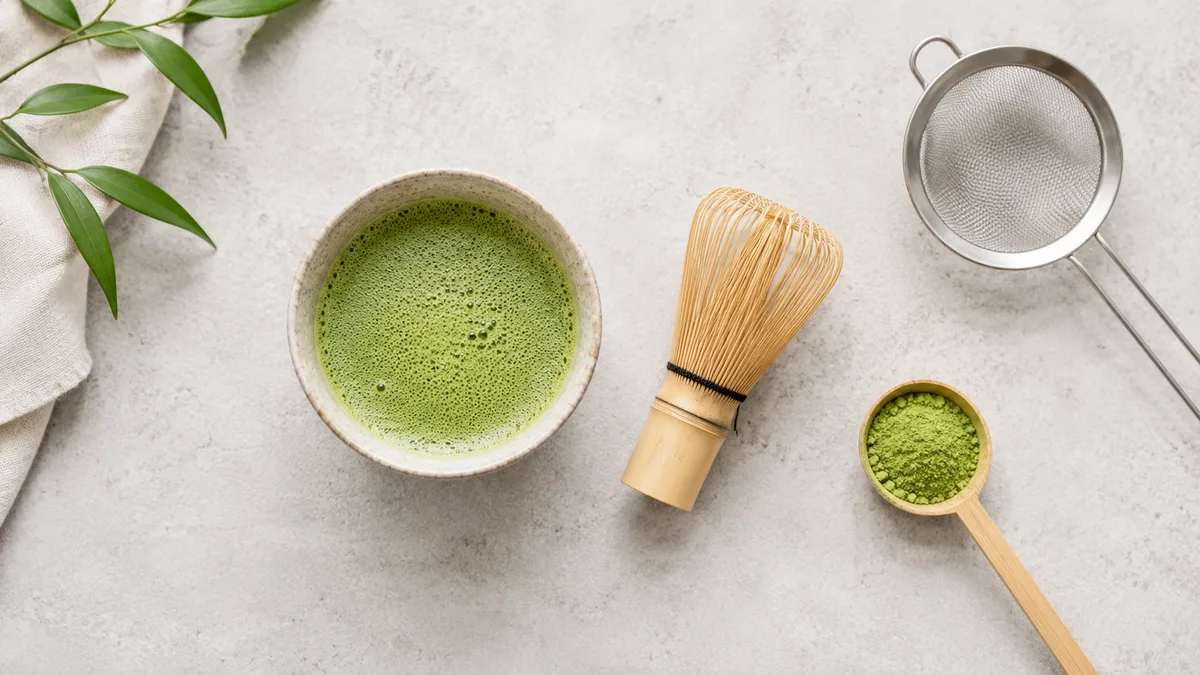
- Chasen (bamboo whisk): the traditional tool. Creates the best froth, gentle on the powder. Costs €8–15. Worth buying if you plan to drink matcha regularly.
- Small balloon whisk: a standard kitchen whisk works. The result is slightly less frothy but entirely acceptable.
- Electric milk frother: fast and effective. Works particularly well for lattes.
- Jar with a lid: a mason jar shaken vigorously also works for lattes, though not for straight matcha.
Nice to have but not essential:
- A fine-mesh sieve for sifting (removes clumps, improves texture)
- A small pouring kettle for temperature control
The most common equipment mistake is over-investing before knowing whether you enjoy matcha. An electric milk frother (which many people already own) and a regular glass let you start without any additional purchase.
How Do I Make My First Cup?
Straight matcha (the simplest version)
- Heat water to 70°C. Boil a kettle and let it sit for 5–6 minutes, or use a temperature-controlled kettle.
- Measure 1.5g of matcha (about ¾ teaspoon). If you have a sieve, sift it directly into your cup. Sifting breaks up clumps and takes 10 seconds.
- Add 60ml of 70°C water. Start with a small amount to form a paste.
- Whisk briskly in a W motion (not circular) until the matcha is fully dissolved and a light froth forms on the surface. This takes 20–30 seconds.
- Drink immediately. Matcha separates quickly.
That is it. Your first cup will take about 3 minutes.
Matcha latte
- Make a matcha paste: 2g of matcha + 30ml of 70°C water, whisked smooth
- Steam or microwave 150ml of milk (oat, almond, or dairy; oat milk is the most popular pairing)
- Pour the hot milk over the paste. Stir gently.
- Optional: add a small amount of honey or maple syrup
What your first month might look like
For most people, the entry into matcha follows three rough phases:
Weeks 1–2: Start with lattes. Milk softens the flavour and makes the first cup more approachable. Stick to the 2g per 150ml milk ratio.
Weeks 3–4: Try your first straight matcha. Same amount (1.5g), but only 60–80ml of water. You will taste the difference from lattes directly.
After month 1: Experiment with the ratio. More powder gives more body; less gives something lighter. Most regular drinkers settle on 1.5–2g for straight matcha and 2–3g for lattes.
If your first cup does not impress, that is normal. The palate takes some time to adjust to umami-forward drinks, just as it does with good coffee or beer. Three or four cups across the first week will give you a realistic picture.
Why Does Water Temperature Matter?
This is the single most common mistake for beginners. Matcha contains catechins, bitter-tasting antioxidants, that are extracted rapidly at high temperatures. Water above 80°C will make any matcha taste harsh and astringent, regardless of quality.
70°C is the right temperature for ceremonial grade matcha. At this temperature, the L-theanine and sweet compounds are extracted without triggering excessive catechin extraction.
In order of frequency, the most common beginner mistakes are: water too hot, then poor quality (culinary grade used for drinking), then an incorrect ratio. If your matcha tastes bitter, the cause is water temperature or quality in 80% of cases, not the powder-to-water ratio.
For hōjicha (our roasted tea), this does not apply; it is not sensitive to temperature and can be brewed with water up to 90°C.
What Does L-Theanine Do?
Many people who switch from coffee to matcha describe a different quality of alertness. This is L-theanine, an amino acid that modulates the caffeine effect by promoting alpha brain waves associated with calm focus. The combination of caffeine and L-theanine produces what researchers in clinical studies describe as "alert calm": mentally clear, without the sharp spike and anxiety-tinged crash that straight caffeine sometimes causes.
At 1.5g per serving, matcha contains approximately 68mg of caffeine (equivalent to one espresso) and around 20mg of L-theanine. The ratio is what matters: L-theanine is present in other teas, but matcha contains it in higher concentration because the shading process actively promotes amino acid production in the plant.
What this actually looks like day-to-day: the focus lasts longer than after an espresso. The pronounced crash two hours later that many people experience after black coffee is less common. That is not an overclaim, but it is not magic either. It is a different combination of the same molecules.
What Does Good Matcha Taste Like?
Good ceremonial matcha is:
- Naturally sweet: not sugary, but with a clean sweetness from L-theanine
- Umami-forward: a savoury depth that is characteristic of shade-grown tea
- Grassy and vegetal: this is normal and desirable; think fresh spinach, not lawn
- No significant bitterness: bitterness means something went wrong (temperature, grade, or both)
If your matcha tastes primarily bitter, troubleshoot in this order: temperature first, grade second, ratio third.
How Should I Store Matcha?
Matcha is sensitive to light, heat, and oxygen. Store in the original tin or a sealed container:
- Room temperature is fine if the tin is away from direct sunlight and heat sources
- Refrigerator storage is acceptable for long-term (more than 6 weeks), but let the tin come to room temperature before opening to avoid condensation
- Use within 6–8 weeks of opening for peak flavour; matcha does not go bad, but the flavour oxidises noticeably over time
Signs that matcha has degraded: the colour shifts from vivid green to olive or grey-green. The smell turns hay-like or flat instead of remaining fresh and vegetal. The white paper test makes it obvious immediately: degraded matcha is noticeably duller.
An opened 30g tin, used for one cup a day, lasts roughly 3–4 weeks. That is a realistic consumption rate for most beginners drinking daily.
Everyday Matcha vs Organic Matcha: Which One for Beginners?
This is the most common question on a first purchase. Both are ceremonial grade, both come from Uji, Kyoto, both suit beginners.
Everyday Matcha Blend is sweeter and rounder. The flavour profile is immediately approachable: natural sweetness, minimal bitterness, clear umami character. For anyone who wants to drink straight matcha in water, this is the better first choice.
Organic Matcha is JAS-certified organic, slightly milder and more balanced. It has a slightly less intense vegetal quality than the Everyday Blend. For anyone who prefers organic products or plans to drink matcha primarily as a latte, this is the natural choice.
If you cannot decide, the Tasting Set includes all three tins (Everyday Matcha, Organic Matcha, Hōjicha), so you can taste the difference directly before committing to a favourite.
Where Should I Start at Satsuki?
If you are new to matcha and unsure where to start:
- Everyday Matcha Blend: ceremonial grade, sweet and smooth, ideal for straight drinking. The most approachable first cup.
- Organic Matcha: JAS-certified organic, slightly milder, works beautifully as a latte. A good choice if you prefer organic products or plan to use matcha across multiple preparations.
- Tasting Set: all three tins (Everyday Matcha, Organic Matcha, Hōjicha). The natural choice if you want to understand the range before committing to a favourite.
For deeper reading on Japanese tea culture and production, Perfect Daily Grind and World Tea News publish consistently reliable coverage of specialty tea sourcing, trends, and preparation techniques.